

A desk-side briefing is a direct, structured meeting between journalists and organisational representatives that provides contextual information, evidence, clarification, and subject-matter expertise beyond a standard media announcement. Journalists often produce more accurate and comprehensive coverage after a desk-side briefing because it improves information access, strengthens source evaluation, and reduces ambiguity during editorial assessment.
Public affairs refers to the management and communication of information between institutions, stakeholders, policymakers, media organisations, and the public. Digital advocacy is the strategic distribution of information that influences visibility, interpretation, and stakeholder understanding across digital ecosystems.
What Is a Desk-Side Briefing?
A desk-side briefing is a media engagement format designed to provide journalists with direct access to information, expertise, and institutional context.
Within public affairs and reputation ecosystems, a desk-side briefing refers to a structured conversation between an organisation and a journalist that expands upon information already available through press releases, reports, statements, or public disclosures. The objective is not promotion but clarification, explanation, and contextualisation. Journalists receive access to background information that assists editorial evaluation and source verification.
The mechanism operates through information enrichment. A press release communicates facts, while a desk-side briefing explains relationships, implications, evidence, terminology, and strategic context. This additional layer of understanding allows journalists to assess credibility signals more effectively. As a result, editorial interpretation becomes more informed and less dependent on assumptions.
From a perception standpoint, desk-side briefings contribute to institutional visibility because they increase informational depth. Search ecosystems and media ecosystems both reward clarity, expertise, and source reliability. Information that is well contextualised produces stronger authority signals than isolated announcements.
Why Do Journalists Give Better Coverage After a Desk-Side Briefing?
Journalists provide better coverage after a desk-side briefing because information quality improves before publication.
Editorial decision-making depends on evidence evaluation, source credibility, contextual understanding, and factual accuracy. A desk-side briefing improves each of these factors. Journalists gain access to explanations that help interpret data, policies, initiatives, research findings, or institutional decisions. This process reduces information gaps that often create incomplete reporting.
The mechanism centres on source enrichment. Direct interaction allows journalists to verify claims, clarify terminology, examine supporting evidence, and understand broader implications. Better source evaluation produces stronger editorial confidence and improves narrative precision.
The impact extends beyond a single article. High-quality media coverage contributes to reputation signals that influence digital visibility. Search engines analyse content quality, topical relevance, source authority, and entity relationships during content indexing and SERP evaluation. Accurate media coverage therefore becomes part of a wider perception ecosystem.
How Does Context Influence Media Interpretation?
Context defines how information is interpreted, prioritised, and communicated.
In media environments, facts rarely operate independently. Journalists evaluate facts within broader frameworks that include policy developments, industry trends, stakeholder interests, institutional objectives, and public relevance. A desk-side briefing provides this contextual layer and supports accurate interpretation.
The mechanism functions through narrative framing. Narrative framing refers to the structure used to organise information into a coherent explanation. When context is absent, journalists rely on external sources to establish meaning. When context is available, interpretation becomes more precise and evidence-based.
The effect on institutional perception is significant. Context improves understanding, reduces misinterpretation, and strengthens credibility assessment. Within digital ecosystems, context also assists content indexing because search systems analyse topical relationships and semantic relevance when evaluating information quality.
How Are Authority and Trust Evaluated Across Digital Ecosystems?
Authority and trust are evaluated through observable reputation signals distributed across interconnected digital environments.
Digital authority refers to the perceived expertise, reliability, and credibility associated with an entity. Stakeholder trust refers to confidence generated through consistent, verifiable, and transparent information. Search engines, media organisations, researchers, and audiences all evaluate these signals using different assessment frameworks.
The mechanism involves signal aggregation. Search systems analyse citations, media mentions, topical expertise, content consistency, source reliability, and entity associations. Journalists similarly evaluate expertise indicators, evidence quality, transparency, and historical credibility when selecting sources.
Authority becomes visible when multiple independent sources reinforce the same entity perception. Trust becomes visible when information remains consistent across channels, publications, and stakeholder interactions. Together, these signals influence both media coverage and search visibility.
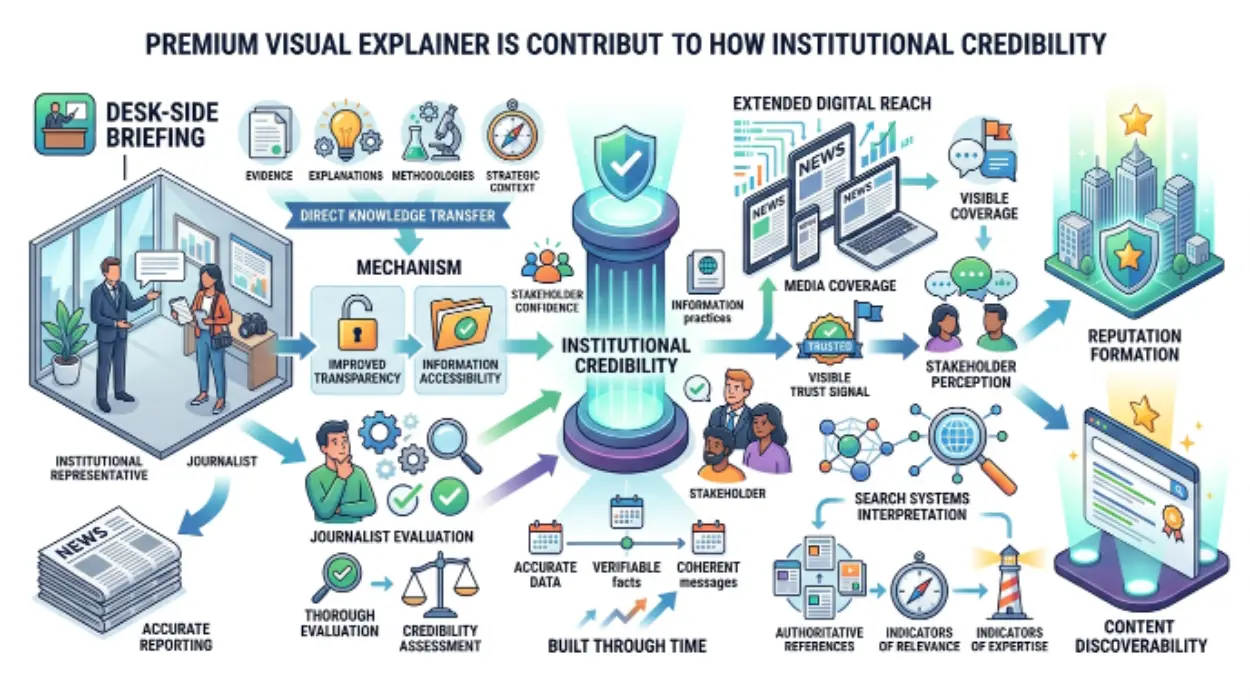
What Role Do Desk-Side Briefings Play in Institutional Credibility?
Desk-side briefings contribute to institutional credibility by improving transparency and information accessibility.
Institutional credibility refers to the degree of confidence stakeholders place in an organisation’s information, expertise, and communication practices. Credibility is formed through repeated exposure to accurate, verifiable, and coherent information rather than through isolated messages.
The mechanism operates through direct knowledge transfer. Journalists gain access to evidence, explanations, methodologies, and strategic context. This process allows information to be evaluated more thoroughly before publication. Enhanced understanding supports more accurate reporting and stronger credibility assessment.
The impact extends across digital channels. Media coverage functions as a visible trust signal that influences stakeholder perception. Search systems frequently interpret authoritative media references as indicators of relevance and expertise. Consequently, institutional credibility contributes to both reputation formation and content discoverability.
How Do Media Narratives Shape Public Perception?
Media narratives shape public perception by determining how information is organised, connected, and interpreted.
A narrative is the structure through which facts acquire meaning. Narrative influence refers to the effect that information organisation has on audience understanding. Public perception emerges from repeated exposure to narratives across news platforms, search results, social discussions, and institutional publications.
The mechanism involves information sequencing. Journalists decide which facts receive prominence, which sources receive visibility, and which contextual elements define interpretation. These editorial decisions establish perception frameworks that audiences use when evaluating institutions, policies, and issues.
Narrative influence directly affects reputation outcomes. Positive or negative sentiment alone does not determine perception. Instead, clarity, consistency, authority, and contextual relevance shape long-term stakeholder understanding. Search ecosystems reinforce this process because highly visible narratives receive greater exposure through SERP rankings and content discovery mechanisms.
How Do Search Engines Interpret Media Coverage as Reputation Signals?
Search engines interpret media coverage as a collection of authority, relevance, and trust indicators.
Media coverage represents an external validation source within digital ecosystems. When credible publications reference an institution, search systems identify relationships between entities, topics, expertise areas, and information sources. These relationships contribute to entity understanding and search evaluation processes. The principles behind Press Release Writing for AI Crawlers: How to Write for Both Journalists and Search Engines Simultaneously demonstrate how content structure influences both journalistic interpretation and content indexing across search ecosystems.
The mechanism includes multiple analytical layers:
- Identify entity relationships – Search systems connect organisations, topics, individuals, and publications through semantic analysis and knowledge graph structures.
- Evaluate source authority – Content from established publications contributes stronger reputation signals because editorial standards increase information reliability.
- Measure topical relevance – Coverage focused on a specific expertise area strengthens topical authority and subject-matter association.
- Assess consistency – Repeated alignment between institutional information and external reporting reinforces credibility signals across content ecosystems.
These processes influence search visibility because algorithms evaluate information quality using interconnected signals rather than isolated webpages. Reputation therefore exists as a distributed digital asset formed through multiple information sources.
What Is the Relationship Between Stakeholder Trust and Information Accessibility?
Stakeholder trust increases when information accessibility improves.
Information accessibility refers to the ease with which stakeholders can obtain, understand, verify, and evaluate information. Trust formation depends on transparency, consistency, and evidence availability. When stakeholders encounter barriers to understanding, uncertainty increases and confidence declines.
The mechanism centres on information verification. Journalists, researchers, policymakers, and audiences require access to supporting evidence before assigning credibility. Desk-side briefings improve accessibility by providing explanations that complement formal communications. This process enhances understanding without altering underlying facts.
The impact on perception systems is measurable through visibility and credibility outcomes. Information that is accessible generates stronger engagement, more accurate interpretation, and improved reputation signals. Search systems similarly reward content structures that provide clarity, relevance, and informational completeness.
How Does Digital Footprint Influence Institutional Visibility?
A digital footprint influences institutional visibility by determining how an entity appears across interconnected information environments.
A digital footprint refers to the cumulative collection of content, references, mentions, media coverage, publications, and stakeholder interactions associated with an entity. Every indexed asset contributes to overall entity perception and discoverability.
The mechanism functions through content accumulation. Search engines collect signals from websites, news publications, research documents, social platforms, and public records. These signals help define institutional identity, expertise areas, and credibility indicators within search ecosystems.
The visibility impact is substantial because digital footprints influence SERP evaluation. Institutions with coherent information ecosystems demonstrate stronger authority signals than entities with fragmented or inconsistent digital presences. Media coverage generated through informed reporting contributes directly to this footprint and shapes long-term perception.
Why Does Information Depth Matter in Reputation and Visibility Systems?
Information depth matters because digital ecosystems evaluate quality through comprehensiveness, context, and expertise.
Information depth refers to the extent to which content explains relationships, evidence, implications, and subject matter complexity. Surface-level information communicates facts, while deeper information explains meaning and relevance.
The mechanism involves semantic evaluation. Search engines analyse topical coverage, contextual relationships, entity associations, and informational completeness. Journalists apply similar evaluation processes when assessing sources and developing coverage. Both systems reward information that demonstrates expertise and clarity.
The resulting effect is improved credibility assessment. Comprehensive information strengthens authority signals, supports stakeholder understanding, and improves content indexing performance. Desk-side briefings contribute to this process by expanding informational depth before narratives enter the public information environment.
Conclusion
A desk-side briefing is a structured information exchange that improves journalistic understanding through context, explanation, evidence, and direct source access. Better coverage emerges because journalists can evaluate credibility, verify information, and interpret institutional narratives with greater precision.
Across public affairs and digital advocacy ecosystems, perception is formed through interconnected systems of authority, trust, visibility, and narrative influence. Media coverage functions as a reputation signal, while search engines evaluate credibility through entity relationships, topical relevance, content indexing patterns, and digital authority indicators. Desk-side briefings therefore represent an information mechanism that strengthens contextual understanding and contributes to more accurate perception formation across both media and search environments.
Frequently Asked Questions
What is the purpose of a desk-side briefing?
A desk-side briefing provides journalists with additional context, evidence, and expert insights that are not always included in a press release. Its purpose is to improve understanding, support accurate reporting, and help journalists evaluate information within a broader institutional or policy context.
How is a desk-side briefing different from a press release?
A press release delivers a structured announcement, while a desk-side briefing provides direct explanation and clarification. The briefing allows journalists to ask questions, verify information, and gain a deeper understanding of the subject matter before producing coverage.
Why do desk-side briefings improve media coverage?
Desk-side briefings improve media coverage because they reduce information gaps and increase contextual understanding. Journalists receive access to supporting evidence, background information, and expert explanations, which strengthens editorial accuracy and narrative precision.
How do desk-side briefings influence institutional reputation?
Desk-side briefings influence institutional reputation by supporting transparent communication and improving the quality of media narratives. Accurate reporting contributes to stronger reputation signals, enhances stakeholder trust, and reinforces perceptions of credibility and expertise.
Do desk-side briefings affect search visibility?
Desk-side briefings indirectly affect search visibility because they can contribute to higher-quality media coverage. Authoritative media references become part of an entity’s digital footprint, creating reputation signals that search engines use when evaluating authority, relevance, and credibility.