

Press release writing for AI crawlers requires content structures that support both journalistic evaluation and machine interpretation. Effective press releases combine newsworthiness, entity clarity, and semantic relevance to improve visibility across media ecosystems and search environments.
Public affairs strategies differ based on audience interpretation mechanisms, content distribution channels, and trust validation systems. Digital advocacy methods are evaluated through visibility outcomes, reputation signals, stakeholder trust indicators, and search ranking influence across interconnected information networks.
How Does Press Release Writing for AI Crawlers Differ from Traditional Media Relations Approaches?
Press release writing for AI crawlers is a content optimisation approach that combines journalistic standards with machine-readable information structures. Traditional Media Relation approaches focus primarily on journalist evaluation, editorial relevance, and newsroom decision-making processes. Both approaches aim to increase narrative visibility, but they operate through different discovery mechanisms.
Traditional press releases depend on editorial gatekeepers who assess relevance, timeliness, evidence, and public interest. Direct journalist engagement methods such as desk-side briefings provide additional context that influences editorial decision-making and coverage quality.
The comparative advantage of traditional media-focused releases lies in editorial endorsement and third-party validation. The limitation is dependency on publication decisions outside organisational control. AI crawler optimisation provides scalable discoverability across search environments but depends on structured content quality and entity credibility signals. The combined approach strengthens both media coverage potential and long-term search visibility.
From a reputation strategy perspective, integrating both methods improves stakeholder access to information while supporting narrative consistency. This combination contributes to stronger institutional credibility because both human evaluators and machine systems receive aligned information signals.
Which Content Structures Perform Better for Journalists and Search Engines?
Structured content frameworks perform more effectively across both journalistic and search environments than narrative-heavy formats. Content structure is the organisational arrangement of information that influences interpretation, indexing, and editorial review.
Journalists prioritise information hierarchy. Search engines prioritise semantic clarity. Both systems evaluate relevance through contextual relationships between entities, topics, and supporting evidence. A structured framework typically includes a clear headline, concise summary, factual lead paragraph, supporting evidence, expert attribution, and contextual background information.
Search engines analyse entity relationships embedded within headings, body content, and supporting references. Journalists analyse the same information through relevance, credibility, and audience value assessments. The overlap between these evaluation systems creates opportunities for dual optimisation.
Comparative analysis reveals that heavily promotional content weakens performance across both channels. Excessive marketing language reduces editorial appeal and creates ambiguity for machine interpretation. Structured factual content improves narrative visibility because information remains accessible to both human and algorithmic evaluators.
Institutional trust increases when content architecture supports transparency, evidence verification, and consistent entity representation. These factors strengthen both search ranking influence and stakeholder perception.
What Structural Elements Support Dual Optimisation?
The most effective structural elements include:
- Define entities clearly through consistent organisational and stakeholder references.
- Present facts early through summary-focused introductory sections.
- Organise information hierarchically using descriptive headings.
- Support claims with attributable evidence and contextual data.
- Maintain semantic consistency across related topics and themes.
Each element improves machine interpretation while supporting editorial assessment processes.
How Do Entity-Based Writing Approaches Compare with Keyword-Focused Press Releases?
Entity-based writing provides stronger long-term visibility than isolated keyword-focused approaches. An entity is a recognised person, organisation, policy issue, institution, event, or concept that search systems can identify and connect across information sources.
Keyword-focused press releases operate by targeting specific search terms. Entity-based press releases operate by strengthening contextual relationships between recognised subjects and relevant topics. Search engines increasingly evaluate entities because they provide clearer indicators of authority and expertise.
Keyword optimisation remains useful for topic relevance and query matching. However, keyword-focused strategies often create fragmented content structures when relevance takes priority over contextual depth. Entity-focused approaches strengthen semantic understanding because related concepts are connected within a broader knowledge framework.
For journalists, entity-rich content provides clearer contextual understanding. For search systems, entity relationships improve topical authority assessment. The result is stronger narrative visibility across both media and search ecosystems.
From a reputation management perspective, entity-based optimisation supports long-term institutional recognition. It improves entity credibility by establishing consistent associations between organisations, stakeholders, issues, and outcomes.
How Does AI Interpretation Influence Press Release Visibility Compared with Editorial Coverage?
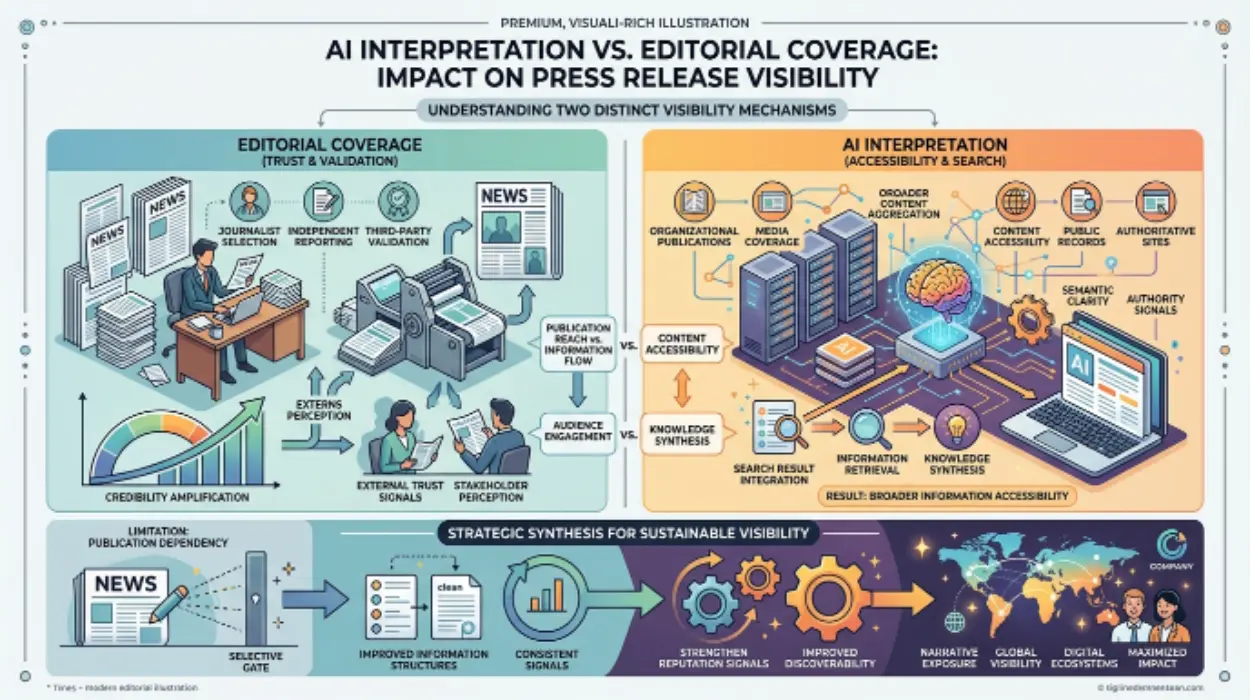
AI interpretation expands visibility pathways beyond traditional editorial publication. Editorial coverage depends on journalist selection, while AI interpretation depends on content accessibility, semantic clarity, and authority signals.
Editorial coverage remains valuable because independent reporting generates external trust signals. News articles often influence stakeholder perception through third-party validation. AI systems, however, aggregate information from broader content ecosystems including organisational publications, media coverage, public records, and authoritative websites.
This creates two distinct visibility mechanisms. Editorial visibility operates through publication reach and audience engagement. AI visibility operates through information retrieval, knowledge synthesis, and search result integration. Both contribute to narrative exposure but through different channels.
The strength of editorial coverage lies in credibility amplification. The limitation is publication dependency. AI-driven visibility provides broader information accessibility but requires consistent semantic signals and trustworthy source networks.
Institutions seeking sustainable visibility benefit from approaches that support both mechanisms. Consistent information structures improve discoverability while strengthening reputation signals across digital ecosystems.
What Is More Effective for Reputation Signals: Reactive Press Releases or Strategic Narrative Development?
Strategic narrative development creates stronger reputation signals than purely reactive communication. Reactive press releases respond to events, issues, or emerging discussions. Strategic narrative development establishes consistent thematic positioning over time.
Reactive communication operates by addressing immediate visibility requirements. It can support content suppression efforts during periods of heightened scrutiny by introducing accurate information into the information environment. However, reactive approaches often create fragmented messaging when disconnected from broader communication objectives.
Strategic narrative development operates by reinforcing recurring themes, expertise areas, institutional priorities, and stakeholder commitments. Search engines and AI systems identify these patterns through repeated associations across content ecosystems. Journalists also recognise consistency as an indicator of credibility and organisational coherence.
Comparative evaluation shows that reactive communication supports short-term narrative management. Strategic narrative development supports long-term entity credibility and stakeholder trust. Organisations relying exclusively on reactive responses often experience inconsistent sentiment distribution because information lacks thematic continuity.
Sustainable reputation strategies integrate both approaches. Immediate responses address emerging issues while long-term narrative frameworks reinforce institutional credibility and visibility.
How Do Trust Signals Affect Press Release Performance Across Digital Ecosystems?
Trust signals directly influence both editorial evaluation and machine-based visibility assessment. Trust signals are indicators that demonstrate accuracy, authority, transparency, and reliability.
Journalists assess trust through source credibility, evidence quality, expert attribution, and factual consistency. Search engines assess trust through authority signals, content quality indicators, citation relationships, and entity credibility patterns. Although evaluation methods differ, both systems reward trustworthy information.
Press releases containing transparent sourcing, verifiable claims, and contextual evidence generate stronger trust indicators. Unsupported claims weaken both editorial appeal and algorithmic confidence. The resulting impact affects narrative visibility, search ranking influence, and stakeholder trust simultaneously.
A comparison between evidence-led content and assertion-led content demonstrates clear performance differences. Evidence-based releases support credibility assessment. Assertion-driven releases increase scepticism and reduce information reliability signals.
Trust signals also influence institutional resilience. Strong credibility indicators contribute to stable sentiment distribution and reduced vulnerability to misinformation or conflicting narratives.
How Does Search Ranking Influence Compare with Media Placement Influence?
Search ranking influence and media placement influence contribute to visibility through different mechanisms. Search rankings affect discoverability within information retrieval systems. Media placements affect credibility through third-party publication.
Search visibility operates continuously. Information remains accessible through search queries, AI-generated responses, and knowledge retrieval systems. Media placements operate through audience exposure generated by individual publications and editorial channels.
The advantage of search visibility lies in scalability and persistence. Content can remain discoverable long after publication. The advantage of media placement lies in independent validation and audience trust transfer. Editorial endorsement often enhances stakeholder perception more effectively than self-published content alone.
Comparative evaluation indicates that search ranking influence strengthens long-term visibility infrastructure. Media placement influence strengthens external credibility. Organisations that prioritise one channel exclusively often experience imbalances between discoverability and trust.
A balanced approach aligns search optimisation with media relations objectives. This combination supports narrative visibility, reputation signals, and stakeholder confidence simultaneously.
Which Evaluation Framework Best Measures Press Release Effectiveness in Modern Digital Environments?
Multi-dimensional evaluation frameworks provide the most accurate assessment of press release effectiveness. Single metrics fail to capture the interconnected nature of media visibility, search performance, stakeholder perception, and reputation outcomes.
Effective evaluation frameworks measure:
- Analyse search visibility through entity presence and ranking performance.
- Measure media coverage through publication quality and contextual relevance.
- Evaluate sentiment distribution across media and digital platforms.
- Assess stakeholder trust indicators through engagement quality.
- Compare narrative visibility against competing information sources.
Each metric reflects a different component of communication effectiveness. Search visibility measures discoverability. Media coverage measures editorial recognition. Sentiment distribution evaluates perception patterns. Stakeholder trust assesses credibility outcomes.
Modern digital ecosystems require integrated measurement because search engines, AI systems, journalists, and stakeholders interact within the same information environment. Effective evaluation analyses relationships between these variables rather than isolated outputs. This measurement methodology aligns closely with established frameworks used to assess media relations success across visibility, sentiment, and share-of-voice indicators.
This approach provides a more accurate understanding of how press releases influence visibility, trust signals, and institutional credibility over time.
Conclusion
Press release writing for AI crawlers differs from traditional media-focused approaches because it addresses both machine interpretation and editorial evaluation simultaneously. Structured content, entity-based optimisation, trust signal development, and strategic narrative consistency strengthen performance across search and media ecosystems.
The comparison between reactive and strategic communication frameworks highlights the distinction between short-term narrative management and long-term institutional credibility. Search ranking influence improves discoverability, while media placement influence strengthens external validation and stakeholder trust.
Modern Media Relation strategies increasingly depend on integrated approaches that align journalistic requirements with semantic search principles. Effective evaluation therefore measures visibility, reputation signals, sentiment distribution, entity credibility, and stakeholder trust as interconnected components of digital communication performance.
Frequently Asked Questions
What is press release writing for AI crawlers?
Press release writing for AI crawlers is the practice of structuring content so that both journalists and search systems can interpret information accurately. It combines news reporting principles with semantic content optimisation, entity recognition, and contextual relevance.
How do AI crawlers evaluate press releases?
AI crawlers evaluate press releases by analysing entities, topical relationships, authority signals, content structure, and source credibility. These systems assess how information connects to recognised topics and whether the content demonstrates trustworthiness and relevance.
Why are entity-based press releases more effective than keyword-focused releases?
Entity-based press releases provide clearer contextual signals because they connect organisations, stakeholders, issues, and events within a semantic framework. This improves content understanding, search visibility, and entity credibility across digital ecosystems.
How do press releases influence search visibility?
Press releases influence search visibility by creating indexable content that supports entity recognition, topical authority, and reputation signals. Well-structured releases contribute to search ranking influence when they provide relevant, credible, and contextually connected information.
What metrics measure the effectiveness of a press release strategy?
Press release effectiveness is measured through search visibility, media coverage quality, sentiment distribution, stakeholder trust indicators, narrative visibility, and entity credibility. These metrics provide a comprehensive evaluation of communication performance across media and search environments.