

Maximum press release syndication in 2025 depends on structured wire distribution, entity-based targeting, and alignment with search-driven authority signals rather than volume-based dissemination.
Public affairs strategies differ based on distribution architecture, while digital advocacy methods are evaluated through their influence on narrative visibility, stakeholder trust, and search ranking signals.
How do wire distribution models compare with direct media outreach in terms of syndication impact?
Wire distribution models deliver scale-driven visibility, while direct media outreach generates authority-weighted narrative placement.
Wire distribution is a structured dissemination system where press releases are syndicated across a network of affiliated publishers, aggregators, and data platforms. It operates by pushing uniform content simultaneously to multiple endpoints, creating immediate indexation across search engines and news discovery systems. This approach prioritises reach, frequency, and speed, contributing to rapid search engine recognition and baseline visibility signals. However, its reliance on templated distribution limits editorial differentiation, which constrains narrative depth and reduces perceived entity credibility among high-authority stakeholders.
Direct media outreach is a targeted engagement model where content is pitched to specific journalists, editors, and institutional publishers. It operates by aligning narratives with editorial priorities, enabling contextual integration into trusted media environments. This method strengthens reputation signals through association with credible publications, enhancing stakeholder trust and long-term authority positioning. In contrast to wire distribution, it limits immediate scale but increases qualitative visibility, influencing how search engines interpret expertise and trustworthiness.
From a comparative standpoint, wire distribution amplifies content presence across low- to mid-tier platforms, improving discoverability but diluting narrative control. Direct outreach consolidates authority signals within fewer but more influential placements, improving sentiment distribution and institutional credibility. The effectiveness of each approach depends on whether the objective prioritises immediate SERP saturation or sustained narrative authority within stakeholder ecosystems.
What mechanisms determine press release pickup across digital platforms and search engines?
Press release pickup is determined by indexing signals, entity recognition, and distribution network authority.
Search engines interpret press releases through structured data, publication velocity, and backlink distribution. Wire services operate by embedding releases into high-frequency publishing systems, triggering rapid crawling and indexing. This creates temporal relevance signals, which increase the likelihood of appearing in news verticals and time-sensitive SERP features. However, duplicated content across multiple domains reduces differentiation, leading search engines to consolidate ranking signals rather than elevate individual placements.
Digital platforms evaluate pickup based on engagement metrics and content relevance. Press releases distributed through wires often appear in aggregated feeds, where visibility depends on headline structure, keyword alignment, and entity clarity. Entity-based indexing, where organisations, individuals, and topics are mapped within knowledge graphs, determines whether a release contributes to long-term authority building or remains transient content.
Direct placements operate through editorial validation, where publication authority influences ranking strength. A single high-authority placement can outperform multiple syndicated copies due to stronger domain trust and contextual relevance. This creates a divergence between quantity-driven visibility and quality-driven authority, where the latter has a more sustained impact on search ranking influence and stakeholder perception.
The mechanism comparison highlights that wire-based pickup maximises short-term exposure, while editorial pickup enhances long-term narrative legitimacy and trust signals.
How does content amplification through wire services differ from narrative control strategies?
Content amplification prioritises distribution scale, while narrative control focuses on message precision and contextual integrity.
Wire services function as amplification systems that replicate identical content across multiple channels. This approach operates by increasing the probability of discovery through volume, ensuring that key messages appear across diverse digital environments. It strengthens baseline visibility and supports content suppression strategies by occupying SERP space with controlled narratives. However, amplification reduces adaptability, as identical messaging cannot respond dynamically to stakeholder feedback or evolving discourse.
Narrative control strategies operate through selective placement and message tailoring. These strategies involve adapting content to different audiences, platforms, and institutional contexts, ensuring alignment with stakeholder expectations. By controlling how narratives are framed and distributed, organisations influence sentiment distribution and mitigate reputational risks. This approach enhances trust signals by demonstrating contextual awareness and responsiveness, which are critical in public affairs communication.
The comparison reveals that amplification increases reach but weakens message nuance, while narrative control strengthens credibility but limits distribution scale. In digital advocacy frameworks, the balance between these approaches determines whether a strategy prioritises visibility dominance or reputational precision.

Which approach is more effective: organic distribution or reactive communication frameworks?
Organic distribution establishes consistent authority signals, while reactive communication frameworks address immediate reputational challenges.
Organic distribution is a proactive strategy where content is regularly disseminated through planned channels, including owned media, wire services, and editorial placements. It operates by building cumulative visibility over time, reinforcing entity credibility and stabilising search ranking influence. This approach supports long-term narrative visibility, as consistent publication patterns signal reliability and expertise to both search engines and stakeholders.
Reactive communication frameworks are event-driven strategies activated in response to emerging issues, crises, or shifts in public discourse. These frameworks operate by rapidly deploying targeted messages to counter negative sentiment or clarify narratives. While they provide immediate control over information flow, their effectiveness depends on timing, message clarity, and distribution accuracy. Reactive strategies often rely on both wire distribution for speed and direct outreach for credibility.
Comparatively, organic distribution strengthens institutional trust through sustained engagement, while reactive frameworks manage risk exposure during high-impact events. The limitation of reactive communication lies in its dependency on pre-existing credibility; without established authority signals, reactive messaging lacks influence. Organic strategies, while slower to build impact, provide a stable foundation for narrative resilience and long-term stakeholder trust.
How do short-term syndication tactics compare with long-term institutional credibility strategies?
Short-term syndication tactics prioritise immediate visibility, while long-term strategies focus on sustained authority and trust accumulation.
Short-term syndication involves distributing press releases through wires to achieve rapid pickup and SERP saturation. This approach operates by leveraging high-volume dissemination to dominate search results temporarily, supporting content amplification and visibility control. It is effective for announcements requiring immediate attention, such as policy updates or corporate disclosures. However, its impact diminishes as content loses temporal relevance and duplicated copies are deprioritised by search algorithms.
Long-term institutional credibility strategies involve consistent engagement with authoritative platforms, strategic content placement, and alignment with stakeholder expectations. These strategies operate by building a coherent narrative across multiple touchpoints, reinforcing trust signals and entity recognition. Over time, this approach enhances search ranking influence by associating the entity with reliable, high-quality information sources.
The comparison demonstrates that short-term tactics provide immediate exposure but limited durability, while long-term strategies deliver sustained visibility and stronger stakeholder trust. In public affairs contexts, reliance on short-term syndication without long-term credibility development increases reputational risk and weakens narrative consistency.
What role does targeting play in wire distribution versus stakeholder-focused dissemination?
Targeting determines relevance and engagement quality, influencing both pickup rates and stakeholder perception.
Wire distribution targeting operates at a categorical level, where content is assigned to industry segments, geographic regions, and topic clusters. This approach ensures broad dissemination but lacks precision in reaching specific stakeholder groups. As a result, while visibility increases, engagement depth remains limited, reducing the effectiveness of message delivery in complex public affairs environments.
Stakeholder-focused dissemination is a precision-driven approach where content is tailored and delivered to defined audiences, including policymakers, industry experts, and institutional stakeholders. It operates by aligning messaging with audience-specific concerns, increasing relevance and engagement. This method enhances narrative visibility within targeted ecosystems, strengthening trust signals and improving sentiment distribution.
The comparative analysis shows that wire-based targeting supports scale but compromises relevance, while stakeholder-focused dissemination improves engagement quality and credibility. Effective strategies integrate both approaches, using wire distribution for baseline visibility and targeted dissemination for influence within key stakeholder groups.
How do risk exposure and reputational control differ across distribution strategies?
Risk exposure varies based on control over messaging, distribution speed, and platform authority.
Wire distribution increases exposure to reputational risk due to its scale and lack of editorial filtering. Once content is distributed, it becomes difficult to modify or retract across all platforms, limiting control over narrative evolution. This creates challenges in managing misinformation or unintended interpretations, particularly in sensitive public affairs contexts.
Direct outreach and stakeholder-focused strategies offer greater control over narrative framing and placement. By engaging with trusted media and stakeholders, organisations can shape how messages are interpreted and contextualised. This reduces the likelihood of misrepresentation and enhances reputational stability. However, these approaches require more time and resources, limiting their scalability.
From a risk management perspective, wire distribution prioritises speed over control, while targeted strategies emphasise accuracy and credibility. The optimal approach depends on the balance between urgency and the need for reputational precision, particularly in environments where stakeholder trust is critical.
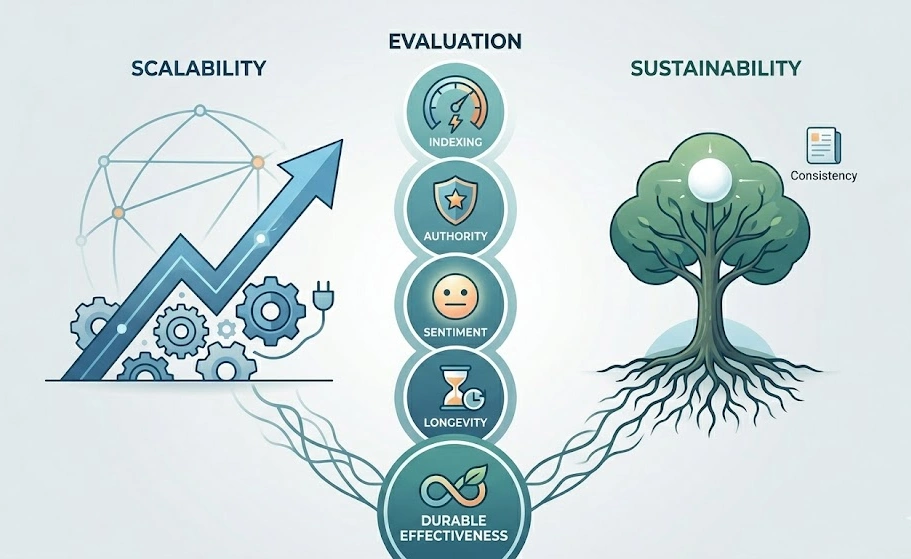
How should press release distribution strategies be evaluated for scalability and sustainability?
Scalability depends on distribution infrastructure, while sustainability depends on credibility accumulation and narrative consistency.
Evaluating scalability involves analysing how efficiently a strategy can expand reach without compromising operational effectiveness. Wire distribution is inherently scalable due to its automated dissemination systems, enabling rapid expansion across multiple platforms. However, scalability does not guarantee sustained impact, as duplicated content limits long-term authority growth.
Sustainability is measured through the persistence of visibility and the strength of trust signals over time. Strategies that prioritise high-authority placements and consistent narrative development demonstrate greater sustainability, as they reinforce entity credibility and improve search ranking influence. These approaches require ongoing investment in content quality and stakeholder engagement, but they deliver more durable outcomes.
An effective evaluation framework includes:
-
Measure indexing speed by analysing how quickly content appears across search engines and news platforms.
-
Assess authority signals by examining the credibility of publishing domains and their influence on ranking.
-
Analyse sentiment distribution by tracking how narratives are perceived across stakeholder groups.
-
Evaluate content longevity by determining how long press releases remain visible and relevant in SERPs.
This framework highlights that scalable strategies must be complemented by sustainable practices to ensure long-term effectiveness in public affairs and digital advocacy contexts.
How does media relation strategy integrate with broader digital advocacy systems?
Media relation strategy functions as a core component of digital advocacy, linking content distribution with stakeholder engagement and narrative management.
Media relations is a structured approach to managing interactions with media entities to influence public discourse and institutional perception. It operates by aligning press release distribution with editorial strategies, ensuring that content contributes to broader advocacy objectives. Within digital ecosystems, media relations integrates wire distribution, direct outreach, and stakeholder targeting to create a cohesive narrative presence.
In digital advocacy systems, media relations supports both content amplification and authority building. It enables organisations to control narrative visibility while reinforcing trust signals through credible placements. The integration of media relations with search optimisation strategies ensures that press releases contribute to both immediate visibility and long-term reputation management.
The relationship between distribution strategies and media relations highlights the importance of balancing scale, precision, and credibility. For further evaluation of strategic considerations, refer to Media Relations and PR Consulting FAQ: What to Know Before You Engage a PR Firm.
Wire strategy effectiveness in 2025 is defined by the balance between distribution scale and authority-driven narrative control. Wire distribution, direct outreach, and stakeholder-focused dissemination each operate through distinct mechanisms that influence visibility, trust signals, and search ranking outcomes.
Short-term syndication tactics enhance immediate SERP presence but lack durability, while long-term credibility strategies strengthen institutional trust and sustained visibility. Organic distribution frameworks build consistent authority, whereas reactive communication addresses immediate reputational risks with variable effectiveness.
Strategic evaluation requires analysing scalability, sustainability, and risk exposure across distribution models. Approaches that integrate amplification with targeted engagement achieve stronger narrative visibility and more stable stakeholder trust, ensuring that press release distribution contributes to both immediate impact and long-term institutional credibility.
Frequently Asked Questions
How do I distribute a press release for maximum syndication in 2025?
Use a wire strategy that combines authoritative distribution networks with targeted editorial outreach to maximise press release syndication in 2025. Linkonize secures high-quality editorial placements through strategic digital PR while wire services ensure broad visibility across news platforms and search engines.
What wire services deliver the best press release pickup in 2025?
Top wire services like PR Newswire, Business Wire, and Newswire deliver strong pickup by distributing through authoritative networks that search engines信任. Linkonize complements wire distribution with targeted journalist outreach to enhance media pickup and reputation signals.
How does wire distribution impact SEO and brand visibility?
Wire distribution generates backlinks and indexed content that improve search ranking influence and branded search visibility. Linkonize uses wire strategy for maximum pickup while adding strategic digital PR to strengthen entity credibility and long-term authority.
When should I use wire distribution versus direct media outreach?
Use wire distribution for broad, immediate visibility and direct outreach for high-authority placements that build stakeholder trust. Linkonize combines both approaches—using wire services for scale and editorial placements for narrative control and institutional credibility.
What makes a press release get picked up by major news outlets in 2025?
Major outlets pick press releases with strong news value, clear entity messaging, and placement on authoritative platforms that align with editorial priorities. Linkonize enhances pickup potential by securing high-quality editorial placements through strategic digital PR and targeted journalist relationships.